Summer is right around the corner and most of us are trying to beat the heat from the sun. Of course, it's time to dip at the pool, springs, waterfalls, beaches and the like this time of the year. Well, our little adventure won't be complete without taking with us something to remember from that trip. Some like to bring seashells, stomes, a leaf or beach sand at home but that is not enough right? We want something to brag about to our friends and families from that adventure. Of course, in this social media era, everything should be documented from the food we eat to the places we visit but bringing with you your precious iPhone, or any high end Android phones to places surrounded by water is a bad idea. That's why I'm recommending this super affordable product I brought from www.lazada.com.ph. Honestly, I was eyeing for the GoPro but I really can't afford it. All I really want is to try underwater photos and maybe someday if I can afford to buy a GoPro then why not? For now let's stick to this one if your budget is on the low. Even a mere unemployed student can afford this action camera. I brought it only at a staggering P1995.00 with monopod. I even got 200 peso discount from Lazada. Without further ado, here it is. Tenenn!!!!
The box together with its accessories
List of accessories and its purposes
The enclosed manual - front and back sides scanned version
For image quality please check the photos below.
without filter - original quality of photo (outdoor)
added some filter using Photoshop
without filter - original image - taken indoor
Color adjusted in Photoshop
without filter - original image - taken underwater
edited in Photoshop
Photos below are screenshots from the video (Click image to enlarge photo)
I noticed that the image quality will also depend upon the lighting. Do make sure to take your videos and photos with a good lighting. I noticed that if the water is not that clear or dirty, the photos and videos are not dark and grainy too.
To check the video quality, watch this video right here.
On How to operate the action camera, please check the video below.
How to use the WiFi and what is it's purpose?
The WiFi functionality is of great help. It will help you operate the action camera just by using your smartphone. You will need to download the "iSmartDV" application at the Google Playstore. The app will even make you download the videos and images straight to your smartphone and share it to Instagram, Facebook or any other social media. However, the app cannot directly playback the video. You will need to download it first into your phone to play it. I recommend you shoot short videos only if you don't have enough space in your smartphone. What I like about the iSmartDV app is you you can live preview what you are shooting and in a bigger screen (if your phone has a large screen). This way you can check the angle you are trying to shoot and it serves as a remote control for the shutter button.
TO USE THE WiFi functionality these are the steps:
1. press the power button on your action camera.
2. press the "down" button located the right side of the camera
3. you will notice a text will appear right through your screen "TURNING WiFi ON"
4. get your smartphone.
5. go to settings > turn WiFi ON
6. Select for "Sports Camera 7" network.
7. Enter the Password indicated at your manual. Mine is 1234567890.
8. Check and wait if it's already CONNECTED to the network. ( a CONNECTED text will appear below the network's name)
9. Open the "iSmartDV" app
10. Sometimes the iSmartDV app will crash due to low battery life or when the camera is on standby mode. Check your action camera's battery health or turn the (ON/OFF) lightly to wake it up.
11. Enjoy using the app.
Note: If you're done using the WiFi function of the cam.You may now go back to your Internet's WiFi connection. Again just to SETTINGS> WiFi> Connect to other WiFi network other than " Sports Camera 7" network.
Summer is right around the corner and most of us are trying to beat the heat from the sun. Of course, it's time to dip at the pool, springs, waterfalls, beaches and the like this time of the year. Well, our little adventure won't be complete without taking with us something to remember from that trip. Some like to bring seashells, stomes, a leaf or beach sand at home but that is not enough right? We want something to brag about to our friends and families from that adventure. Of course, in this social media era, everything should be documented from the food we eat to the places we visit but bringing with you your precious iPhone, or any high end Android phones to places surrounded by water is a bad idea. That's why I'm recommending this super affordable product I brought from www.lazada.com.ph. Honestly, I was eyeing for the GoPro but I really can't afford it. All I really want is to try underwater photos and maybe someday if I can afford to buy a GoPro then why not? For now let's stick to this one if your budget is on the low. Even a mere unemployed student can afford this action camera. I brought it only at a staggering P1995.00 with monopod. I even got 200 peso discount from Lazada. Without further ado, here it is. Tenenn!!!!
The box together with its accessories
List of accessories and its purposes
The enclosed manual - front and back sides scanned version
For image quality please check the photos below.
without filter - original quality of photo (outdoor)
added some filter using Photoshop
without filter - original image - taken indoor
Color adjusted in Photoshop
without filter - original image - taken underwater
edited in Photoshop
Photos below are screenshots from the video (Click image to enlarge photo)
I noticed that the image quality will also depend upon the lighting. Do make sure to take your videos and photos with a good lighting. I noticed that if the water is not that clear or dirty, the photos and videos are not dark and grainy too.
To check the video quality, watch this video right here.
On How to operate the action camera, please check the video below.
How to use the WiFi and what is it's purpose?
The WiFi functionality is of great help. It will help you operate the action camera just by using your smartphone. You will need to download the "iSmartDV" application at the Google Playstore. The app will even make you download the videos and images straight to your smartphone and share it to Instagram, Facebook or any other social media. However, the app cannot directly playback the video. You will need to download it first into your phone to play it. I recommend you shoot short videos only if you don't have enough space in your smartphone. What I like about the iSmartDV app is you you can live preview what you are shooting and in a bigger screen (if your phone has a large screen). This way you can check the angle you are trying to shoot and it serves as a remote control for the shutter button.
TO USE THE WiFi functionality these are the steps:
1. press the power button on your action camera.
2. press the "down" button located the right side of the camera
3. you will notice a text will appear right through your screen "TURNING WiFi ON"
4. get your smartphone.
5. go to settings > turn WiFi ON
6. Select for "Sports Camera 7" network.
7. Enter the Password indicated at your manual. Mine is 1234567890.
8. Check and wait if it's already CONNECTED to the network. ( a CONNECTED text will appear below the network's name)
9. Open the "iSmartDV" app
10. Sometimes the iSmartDV app will crash due to low battery life or when the camera is on standby mode. Check your action camera's battery health or turn the (ON/OFF) lightly to wake it up.
11. Enjoy using the app.
Note: If you're done using the WiFi function of the cam.You may now go back to your Internet's WiFi connection. Again just to SETTINGS> WiFi> Connect to other WiFi network other than " Sports Camera 7" network.
There has been a considerable amount of discussion in the admissions world about The Coalition for Access, Affordability, and Success. I remain skeptical about the motives behind this, as I did when I wrote this in the Washington Post. To be clear, however, I believe colleges have the right to create their own admissions platform and conduct the business side of higher education with great latitude. I am merely questioning how a fractured admissions process helps low income students find, apply, get admitted to, and enroll in college; and the use of the term "access" by colleges who have, in general, poor records of providing access to low-income students.
Many school counselors I've talked to are very concerned by what they perceive to be a dearth of information about how this all will work, and there are also lingering concerns about privacy, which have not yet been publicly answered (to the best of my knowledge), even though one component of the application platform--the Locker--is scheduled to open this month.
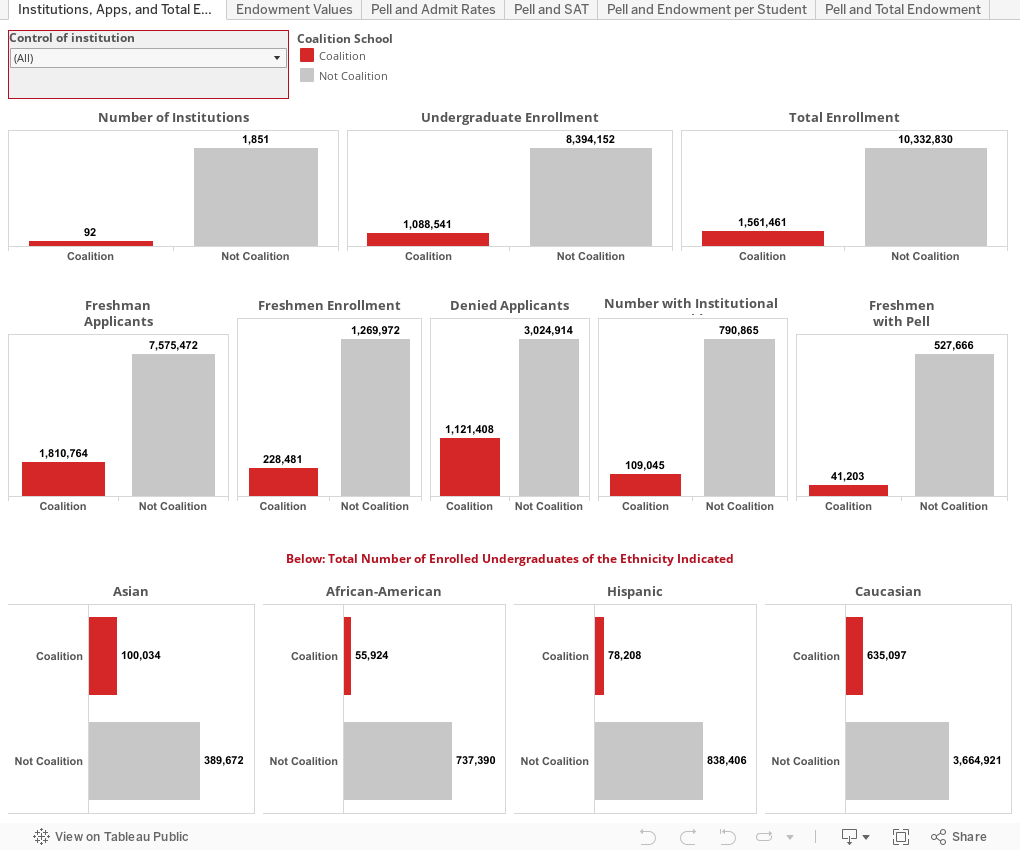
These colleges represent the very top of the pyramid among private institutions, and also include many large, state flagship public institutions, as well as a few statistical outliers. But to look deeper at the data, I downloaded a large IPEDS data set, and just scratched the surface. What should jump out at you is the impressive list of colleges, their collective wealth, and position on several of the scatter grams, below.
Use the tabs across the top. Every view has a filter to show public/private/all institutions. Coalition schools are in red to make them standout; everyone else is in gray. The universe is about 1,945 four-year, degree-granting, Title IV participating colleges and universities in the Midwest.US. (corrected 4/17 at 6:32 pm CST).
What do you see?
- Hallo sahabat The secret, Pada Artikel yang anda baca kali ini dengan judul
, kami telah mempersiapkan artikel ini dengan baik untuk anda baca dan ambil informasi didalamnya. mudah-mudahan isi postingan yang kami tulis ini dapat anda pahami. baiklah, selamat membaca.
There has been a considerable amount of discussion in the admissions world about The Coalition for Access, Affordability, and Success. I remain skeptical about the motives behind this, as I did when I wrote this in the Washington Post. To be clear, however, I believe colleges have the right to create their own admissions platform and conduct the business side of higher education with great latitude. I am merely questioning how a fractured admissions process helps low income students find, apply, get admitted to, and enroll in college; and the use of the term "access" by colleges who have, in general, poor records of providing access to low-income students.
Many school counselors I've talked to are very concerned by what they perceive to be a dearth of information about how this all will work, and there are also lingering concerns about privacy, which have not yet been publicly answered (to the best of my knowledge), even though one component of the application platform--the Locker--is scheduled to open this month.
These colleges represent the very top of the pyramid among private institutions, and also include many large, state flagship public institutions, as well as a few statistical outliers. But to look deeper at the data, I downloaded a large IPEDS data set, and just scratched the surface. What should jump out at you is the impressive list of colleges, their collective wealth, and position on several of the scatter grams, below.
Use the tabs across the top. Every view has a filter to show public/private/all institutions. Coalition schools are in red to make them standout; everyone else is in gray. The universe is about 1,945 four-year, degree-granting, Title IV participating colleges and universities in the Midwest.US. (corrected 4/17 at 6:32 pm CST).
At this time there is no known cure for Types 1 diabetes or Type 2 diabetes. However we are funding pioneering, life-changing research into care, treatment and prevention and working to find a cure for all types of diabetes.
How is diabetes treated, and is there a cure?
Currently, there is no cure for Type 1 diabetes, but it can be treated successfully by administering insulin, either by an injection or pump, and by following a healthy, balanced diet and getting regular physical activity. Looking after diabetes requires planning and attention, which may feel over-whelming at times, especially when your child is first diagnosed. However, there’s no reason for it to stop your child living the healthy, happy and successful life you had hoped for them.
Diabetes UK funded projects
development of an artificial pancreas, a vaccine (Type 1 diabetes)
further understanding of genetic mechanisms, very low-calorie diet (Type 2 diabetes)
Research Project Directory
Our research project directory showcases the diverse and exciting array of diabetes research projects that we are supporting all over the UK. Everything you see is possible thanks to the continued support of our members, donors and voluntary groups – who help us decide which studies deserve the charity's support and help raise the money that is vital to research.
Ever since Diabetes UK awarded its first research grant in 1935 (for £50), we have been one of the largest funders of diabetes research in the UK.
We support a wide range of pioneering initiatives into the causes and prevention of diabetes, improvements in care and treatment and the search for a cure.
A particular focus for 2012-13 has been our targeted research fund, from which we have awarded five new grants that will make a difference to people with diabetes by overcoming barriers to good diabetes care and supported self-management.
Note: You can search for projects in this directory based on the type of research involved or the region or institution where they are taking place – why not find out more about the research projects taking place near you and consider supporting them through our Adopt a Project scheme.
- Hallo sahabat The secret, Pada Artikel yang anda baca kali ini dengan judul
, kami telah mempersiapkan artikel ini dengan baik untuk anda baca dan ambil informasi didalamnya. mudah-mudahan isi postingan yang kami tulis ini dapat anda pahami. baiklah, selamat membaca.
At this time there is no known cure for Types 1 diabetes or Type 2 diabetes. However we are funding pioneering, life-changing research into care, treatment and prevention and working to find a cure for all types of diabetes.
How is diabetes treated, and is there a cure?
Currently, there is no cure for Type 1 diabetes, but it can be treated successfully by administering insulin, either by an injection or pump, and by following a healthy, balanced diet and getting regular physical activity. Looking after diabetes requires planning and attention, which may feel over-whelming at times, especially when your child is first diagnosed. However, there’s no reason for it to stop your child living the healthy, happy and successful life you had hoped for them.
Diabetes UK funded projects
development of an artificial pancreas, a vaccine (Type 1 diabetes)
further understanding of genetic mechanisms, very low-calorie diet (Type 2 diabetes)
Research Project Directory
Our research project directory showcases the diverse and exciting array of diabetes research projects that we are supporting all over the UK. Everything you see is possible thanks to the continued support of our members, donors and voluntary groups – who help us decide which studies deserve the charity's support and help raise the money that is vital to research.
Ever since Diabetes UK awarded its first research grant in 1935 (for £50), we have been one of the largest funders of diabetes research in the UK.
We support a wide range of pioneering initiatives into the causes and prevention of diabetes, improvements in care and treatment and the search for a cure.
A particular focus for 2012-13 has been our targeted research fund, from which we have awarded five new grants that will make a difference to people with diabetes by overcoming barriers to good diabetes care and supported self-management.
Note: You can search for projects in this directory based on the type of research involved or the region or institution where they are taking place – why not find out more about the research projects taking place near you and consider supporting them through our Adopt a Project scheme.
You hear a lot about enrollment of international students these days, and often, I think, when a subject gets a lot of play, it tends to be overhyped, often by people who don't really understand the data.
This would not be one of those times.
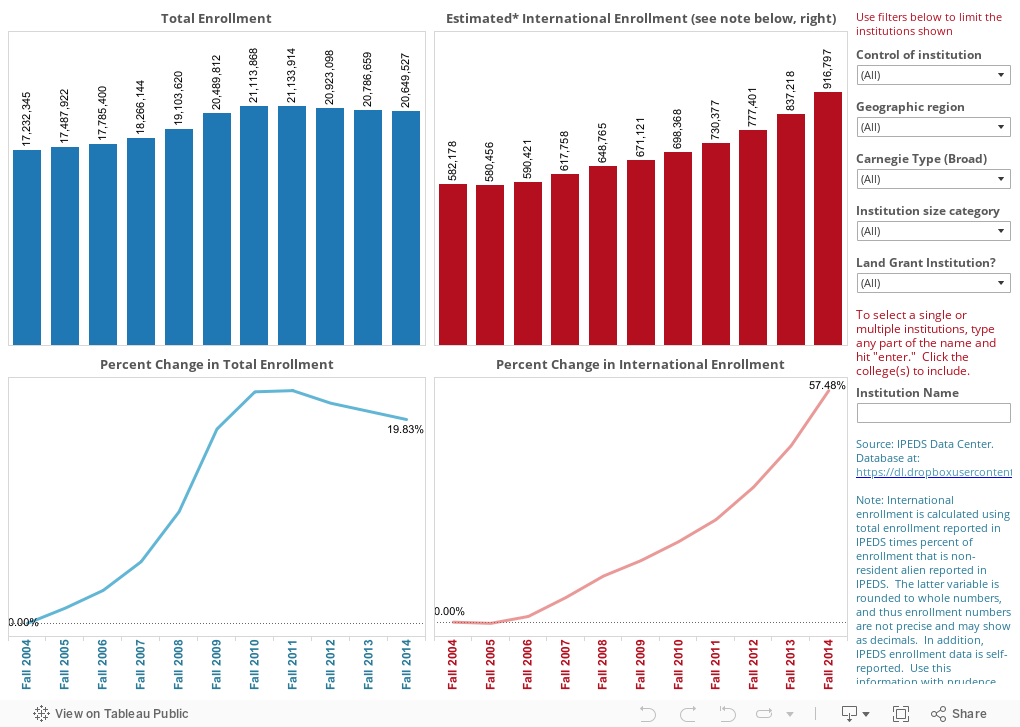
I used IPEDS trend analysis to look at enrollment of non-resident students (that is, students who are neither US citizens nor permanent residents) over time. For comparison's sake, I also looked at overall enrollment over that same time.
This data set includes all 7,276 post-secondary institutions in the US, both degree-granting and non-degree-granting, whether or not they participate in Title IV programs, so my usual advice about IPEDS data is amplified a bit here. Still, the trends are interesting.
The blue charts (on left) show total enrollment at these institutions: Bars show numbers, and the line shows percent change since Fall, 2004. The red charts (right) show estimated international enrollment. It's estimated because I had to calculate it using two variables, and the "percent of students who are non-resident" is expressed in a whole number, which is less precise than I'd like.
Of course, you're probably not interested in all the institutions in the US, so you can use the filters at right to look only at certain subsets, in any combination: Large doctoral universities in the west, for instance, or baccalaureate colleges in New England.
If you reset all those filters (reset button at lower left), you can look at any college or subset of colleges by typing the name in the box and make your selection(s). If you get in trouble, just reset.
What interesting trends do you see here?
- Hallo sahabat The secret, Pada Artikel yang anda baca kali ini dengan judul
, kami telah mempersiapkan artikel ini dengan baik untuk anda baca dan ambil informasi didalamnya. mudah-mudahan isi postingan yang kami tulis ini dapat anda pahami. baiklah, selamat membaca.
You hear a lot about enrollment of international students these days, and often, I think, when a subject gets a lot of play, it tends to be overhyped, often by people who don't really understand the data.
This would not be one of those times.
I used IPEDS trend analysis to look at enrollment of non-resident students (that is, students who are neither US citizens nor permanent residents) over time. For comparison's sake, I also looked at overall enrollment over that same time.
This data set includes all 7,276 post-secondary institutions in the US, both degree-granting and non-degree-granting, whether or not they participate in Title IV programs, so my usual advice about IPEDS data is amplified a bit here. Still, the trends are interesting.
The blue charts (on left) show total enrollment at these institutions: Bars show numbers, and the line shows percent change since Fall, 2004. The red charts (right) show estimated international enrollment. It's estimated because I had to calculate it using two variables, and the "percent of students who are non-resident" is expressed in a whole number, which is less precise than I'd like.
Of course, you're probably not interested in all the institutions in the US, so you can use the filters at right to look only at certain subsets, in any combination: Large doctoral universities in the west, for instance, or baccalaureate colleges in New England.
If you reset all those filters (reset button at lower left), you can look at any college or subset of colleges by typing the name in the box and make your selection(s). If you get in trouble, just reset.
This must be the most devastating year of my life and it's not yet the middle of the year. How much more to the upcoming months? On March 05, 2016 around 4:30 in the early morning, we've lost our baby, our 6 year old Persian cat whom we've loved and grew so fond of since the day we have him in our lives. We don't really know what happened to him because the last time I remember, I left him feeling fine but when I arrived home that day March 03, 2016, he was lying on the floor and did not even bother to greet me which he usually do. I asked my niece, our working student on what happened to Taigah when she arrived home from school. She told me that he vomited almost all her food and there was a huge hairball on it. So, I decided not to feed him that night to let his tummy settle and serve him water only. On the next day, the second day, I noticed, he did not touched his kibbles and only drunk his water. I hold him and checked his body and to my surprise, something is upsetting his stomach since it feels hard. I also noticed his litter box was empty. He didn't even peed which is very unusual. I was really worried and I told my boyfriend that we need to get him to the vet but he insisted that we should wait a little while 'coz that's what he always feel after a hairball situation ever since he's a baby. We tried to feed him NutriPlus gel so he can eat something 'coz I grew really paranoid already. I also feed him virgin coconut oil 'coz the vet told us before that it can help with the hairball situation. We also inserted a kiddie dose of suppository on his rectum 'coz we thought he is only having a constipation which our dog usually suffers. I went to school hoping that when I came home he have vomited or excreted what is it that's inside his stomach but evening came and it didn't. We lived in a small city and there's no legit vet on this area. People with pets only rely on self medication and internet information. It's almost 48 hours and he had not eaten but drank only a little water. I noticed when he got up and tried to walk, his feet shakes and he have this urge to go the litter box but nothing comes out. I blamed myself for my carelessness. It was only 9 in the evening when my fear grew that he is really in pain because every time I lightly press his belly, he will let out a little cry. I let him stayed in my room for the night so I can observe him. He fell asleep and breathing really hard around 12 in the morning. My parents were out of town and we lived far away from the central area of the city. I begged Taigah to please bear with us until 6 in the morning so we can rush him to the hospital. Around 4 in the morning my baby got up for the last time and collapsed. I hysterically panicked and screamed for help. I texted and called everyone I knew who could helped us but it's 4 in the morning and they're sleeping at that time. Nobody can help me (us). My baby did not make it. I held him close as he gasped his last breath. I even attempted to resuscitate him for the hope that he'll come back to life but he didn't. I hugged him until his warm body turned to cold and stiff. We spent a little time until 6 in the morning and reminiscing the time he was still here with us. I can't believe life will just be gone in just a blink of an eye. He was healthy 2 days ago and suddenly he's not. There must be something behind in this tragic incident. I mourned and cried for four consecutive days and after that when my mind cleared up, my boyfriend and I suspected that somebody poisoned my cat and did some research and our suspicion grew stronger. We thought our cat just suffered kidney malfunctions but we think he didn't. The short span of around 48 hours is incredibly suspicious for him to feel sick and eventually die since he was really healthy as far as we've known. While writing this post, I can't help myself but cried helplessly for I want to find justice to whosoever did this to my cat. Nobody has access to my pets but my family members. God so helped me not to let me know that one of them harmed by cat. I will never forgive that person. I can't believe that there are people in this world that will harm a helpless animal. My cat is very sociable and we regretted to train him like that, to be friendly to everyone. I don't know what kind of psychopath I'm dealing with right now since I believe harming animals is a warning that there is something wrong with this person. For now, I'm still coping up with the death of my beloved cat. It's been exactly 2 weeks since he went to the rainbow bridge. Wherever he is right now, I hope he is in good hands. My wish is I hope a plant will grow in his tomb to remind me of him all the time. I want to know that he is still with us in this world. Nobody can comfort me right now but myself. Even if I talk with some friends about it, they seemed not to get what I'm going through right now since they're not really cat lovers. Most of them are dog lovers. As for myself, I love both dogs and cats. There's no in between. That's why I can't just share my emotions with my friends about it. I just can't connect with them. Sharing this experience somehow release a little bit of pain in my heart. I need to talk this out so I can let it out from my chest. It's really hard experiencing loss of a loved one. It's really painful and can't be explained. I hope somebody can take this feeling away from me. I really miss my baby. I'm still terribly devastated and I can't help but blame myself. :(
The world is shrinking, if not literally, then metaphorically. Some colleges and universities embrace this in big ways, and this is the purpose of this visualization.
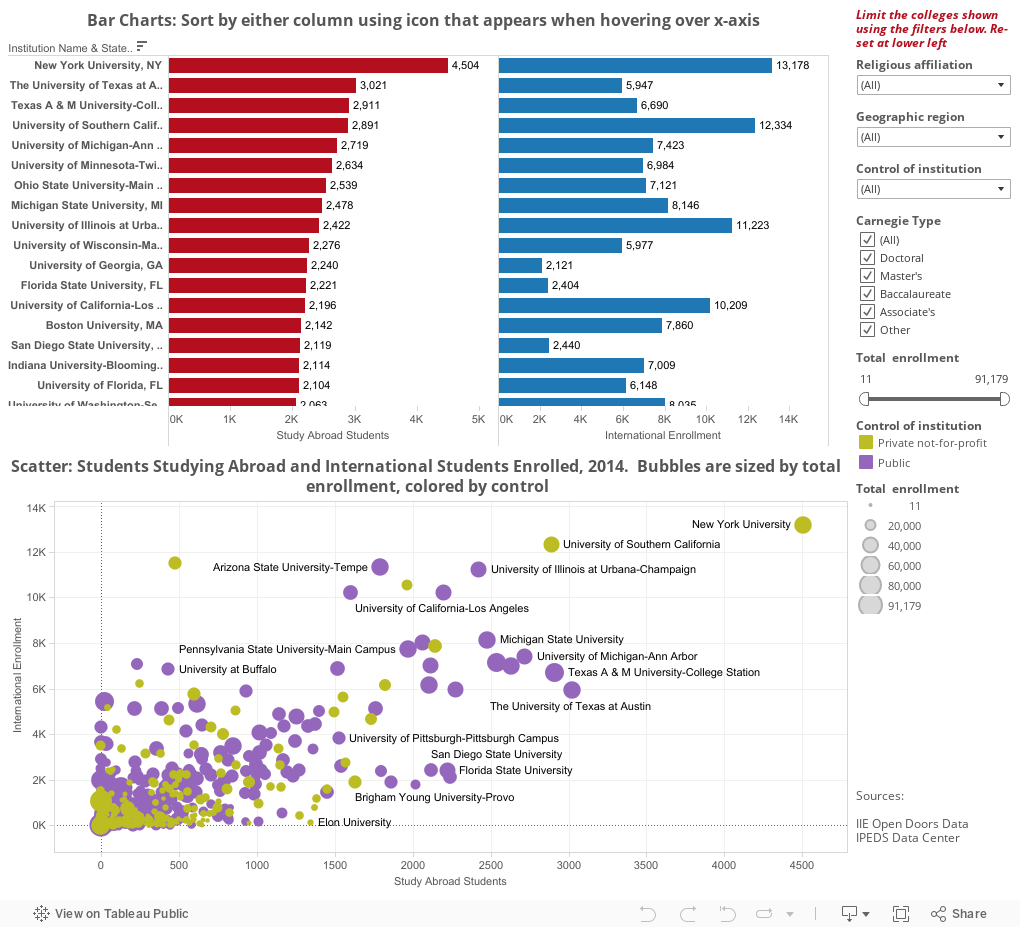
The Institute of International Education puts out good data on both international enrollment at US colleges and enrollment of US students in study abroad programs. I've combined that data into two views that show both.
The top chart contains two sort-able and filterable bar charts. It starts out sorted from large to small on the left column, namely study abroad students in 2014-2015; if you'd rather sort by total international enrollment, hover over that x-axis until the small icon pops up and click that. Reset by using the button at lower left.
The bottom charts shows every college in the data set, with study abroad on the x-axis and international enrollment on the y-axis. Each dot is a college, color coded by control.
As always, if you want to look at a smaller set of colleges, use the filters on the right. They will control both charts at the same time.
Three things: First, the data are for all students, graduate and undergraduate. The IIE data are not broken out, so it's not possible to determine meaningful percentages, except of course for colleges that only enroll undergrads. Second, the data is only reported for colleges that enrolled 10 international students and/or sent 10 students abroad. Assuming the colleges reported the data.
So, on that point: I've checked this data where I seen anomalies; there are several obvious colleges where it's missing. A final caveat: High numbers can be caused by lots of things, including location, wealth of the student body, and curricular offerings, among others. There is (or should be) no value judgment attached to the numbers you find here.
- Hallo sahabat The secret, Pada Artikel yang anda baca kali ini dengan judul
, kami telah mempersiapkan artikel ini dengan baik untuk anda baca dan ambil informasi didalamnya. mudah-mudahan isi postingan yang kami tulis ini dapat anda pahami. baiklah, selamat membaca.
The world is shrinking, if not literally, then metaphorically. Some colleges and universities embrace this in big ways, and this is the purpose of this visualization.
The Institute of International Education puts out good data on both international enrollment at US colleges and enrollment of US students in study abroad programs. I've combined that data into two views that show both.
The top chart contains two sort-able and filterable bar charts. It starts out sorted from large to small on the left column, namely study abroad students in 2014-2015; if you'd rather sort by total international enrollment, hover over that x-axis until the small icon pops up and click that. Reset by using the button at lower left.
The bottom charts shows every college in the data set, with study abroad on the x-axis and international enrollment on the y-axis. Each dot is a college, color coded by control.
As always, if you want to look at a smaller set of colleges, use the filters on the right. They will control both charts at the same time.
Three things: First, the data are for all students, graduate and undergraduate. The IIE data are not broken out, so it's not possible to determine meaningful percentages, except of course for colleges that only enroll undergrads. Second, the data is only reported for colleges that enrolled 10 international students and/or sent 10 students abroad. Assuming the colleges reported the data.
So, on that point: I've checked this data where I seen anomalies; there are several obvious colleges where it's missing. A final caveat: High numbers can be caused by lots of things, including location, wealth of the student body, and curricular offerings, among others. There is (or should be) no value judgment attached to the numbers you find here.
I normally focus on Higher Education data on this blog, and in fact, this visualization started out as a higher education post: I wanted to look at presidential election results from 2012 to see if education played a part in how people voted. But since I had a large census file anyway, with lots of interesting information like income, ethnic groups, and other data, I decided to take it one step farther. OK, may steps farther. And to me, almost everything is ultimately about education.
If you don't like to interact with these visualizations, stop right now. You'll have to play with this to see how it works.
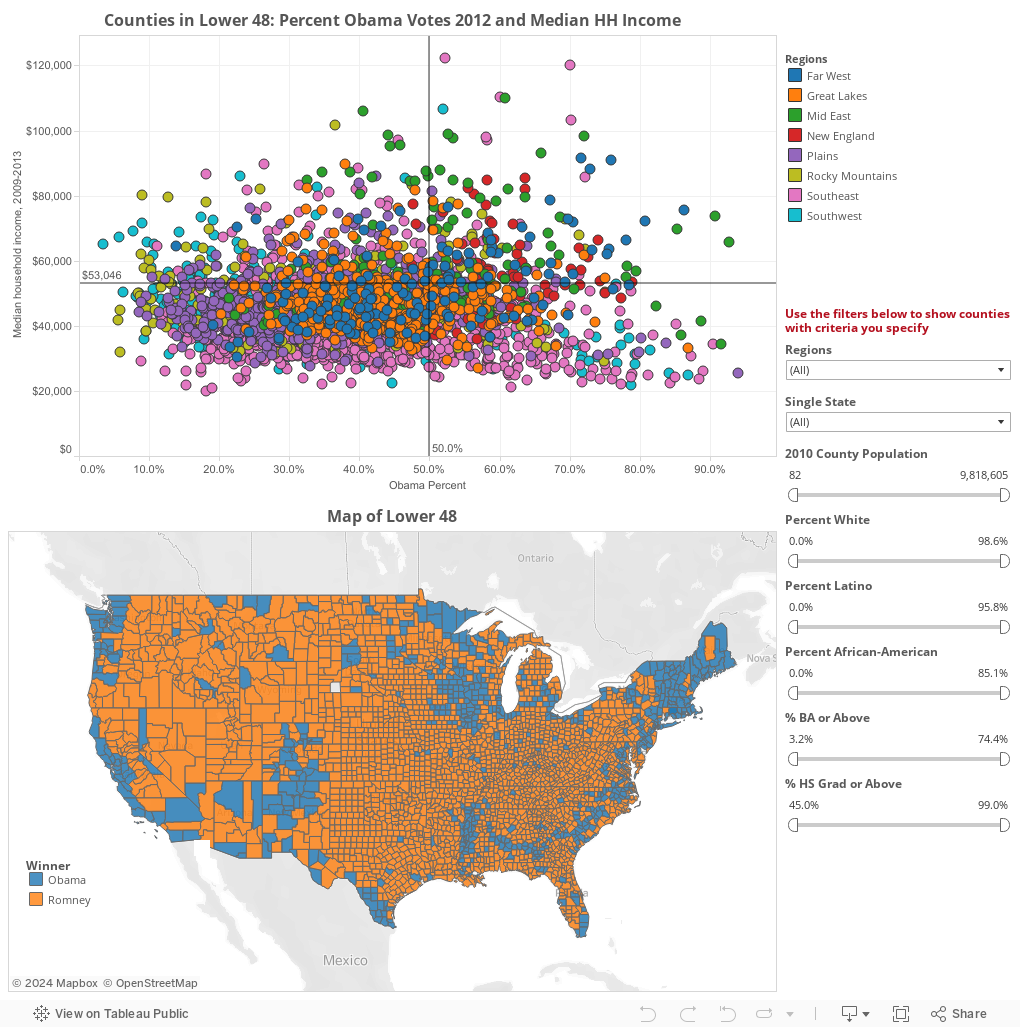
On the top view, you see every county as a dot, color-coded by region, and arranged on a grid. Hover over any dot for details, if you'd like. Counties voting more heavily for Obama are on the right; Romney counties are on the left. Wealthier counties are on top (higher median family income), and poorer are at the bottom. Note the reference line at $53,046, the national median.
If you want to look at a specific state or region, you can do that using the filters. But you can also look only at counties that meet certain demographic criteria, of your choice.
For instance, you could find counties that are at least 15% Hispanic and where at least 10% of the adults have a Bachelor's degree. Once you apply the filters, only the counties that meet those criteria are displayed. Use filters in an combination. (Of course, you can't find any county that's 51% White and 51% African-American; the filters aren't magic.)
The data also shows up on the map at bottom; it's pretty self-explanatory: Each county is colored blue (Obama won) or orange (Romney won.)
As always, the reset button is at bottom.
I find this very interesting, and I hope you do too. And I hope you vote in November; I need you for my next visualization!
- Hallo sahabat The secret, Pada Artikel yang anda baca kali ini dengan judul
, kami telah mempersiapkan artikel ini dengan baik untuk anda baca dan ambil informasi didalamnya. mudah-mudahan isi postingan yang kami tulis ini dapat anda pahami. baiklah, selamat membaca.
I normally focus on Higher Education data on this blog, and in fact, this visualization started out as a higher education post: I wanted to look at presidential election results from 2012 to see if education played a part in how people voted. But since I had a large census file anyway, with lots of interesting information like income, ethnic groups, and other data, I decided to take it one step farther. OK, may steps farther. And to me, almost everything is ultimately about education.
If you don't like to interact with these visualizations, stop right now. You'll have to play with this to see how it works.
On the top view, you see every county as a dot, color-coded by region, and arranged on a grid. Hover over any dot for details, if you'd like. Counties voting more heavily for Obama are on the right; Romney counties are on the left. Wealthier counties are on top (higher median family income), and poorer are at the bottom. Note the reference line at $53,046, the national median.
If you want to look at a specific state or region, you can do that using the filters. But you can also look only at counties that meet certain demographic criteria, of your choice.
For instance, you could find counties that are at least 15% Hispanic and where at least 10% of the adults have a Bachelor's degree. Once you apply the filters, only the counties that meet those criteria are displayed. Use filters in an combination. (Of course, you can't find any county that's 51% White and 51% African-American; the filters aren't magic.)
The data also shows up on the map at bottom; it's pretty self-explanatory: Each county is colored blue (Obama won) or orange (Romney won.)
As always, the reset button is at bottom.
I find this very interesting, and I hope you do too. And I hope you vote in November; I need you for my next visualization!